


This morning, when I woke up and checked my Whoop (the wearable device I use to track my physical metrics), I was genuinely surprised by how much the numbers had improved dramatically. Here’s the breakdown:
- RHR (Resting Heart Rate): Dropped to 55 bpm (from an average of around 60 bpm) Resting heart rate is the number of beats per minute while completely at rest. The lower it is, the fitter and healthier your cardiovascular system generally is.
- VO2 Max: Up to 50 ml/kg/min (from a previous peak that was lower) VO2 max measures the maximum amount of oxygen your body can absorb, transport, and use during high-intensity exercise. Higher VO2 max = better aerobic fitness and endurance.
- RR (Respiratory Rate): Down to 15.5 breaths per minute (from 16.6 bpm) Respiratory rate is the number of breaths you take per minute. Lower is generally better (as long as it’s not too low — if it hits 0, you’re in trouble, haha).
According to current popular classification standards (based on data from the FRIEND registry, INSCYD, and similar benchmarks),
- RHR of 55 bpm is considered good to excellent.
- VO2 max of 50 ml/kg/min is outstanding — putting me in the top 15–30% of men in my age group.
Here are the screenshots directly from my Whoop app (as of January 15, 2026):
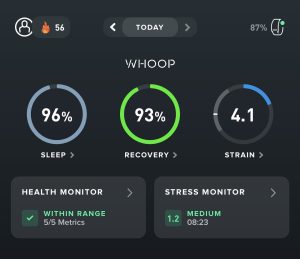
- All metrics are now excellent (compared to my own baseline), except Strain because I haven’t worked out yet today — just writing this blog.
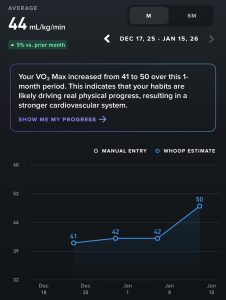
- VO2 max jumped to 50 — seriously impressive.
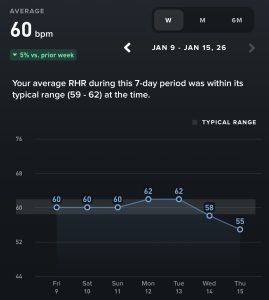
- Resting Heart Rate on January 15, 2026.
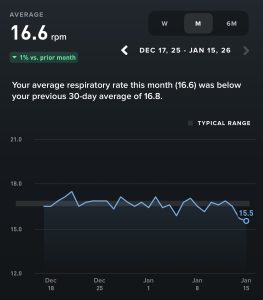
- Respiratory Rate at its all-time lowest.
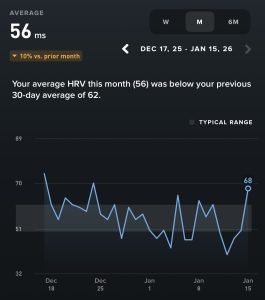
- HRV spiked significantly (though not yet at peak).
Why This Sudden Improvement?
This is the most important part — and honestly, I don’t know the single main cause yet, so I’ll list the most likely possibilities:
Possibility 1: Intense Cardio Session (Zone 5) Two days ago, I did a very hard cardio workout: climbing 150 steep stairs (at a retreat in Hòa Bình) 3–5 times, with my heart rate peaking at 175 bpm. This kind of Zone 5 training is excellent for boosting VO2 max, especially combined with my regular HIIT cycling sessions. However, the stairs had a very steep incline (around 45–55 degrees), which left my calves super tight and somehow caused lower back soreness. That might have contributed to the next possibility.
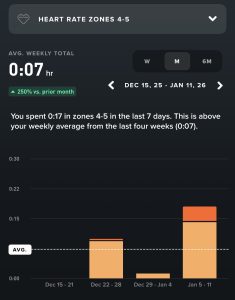
Zone 5 corresponds to heart rate above 171 bpm; Zone 4 is 159–170 bpm
Possibility 2: Anti-Inflammatory & Muscle Relaxant Supplements Because of the back pain and tight calves, I took anti-inflammatory and muscle-relaxant supplements the night before. This could have boosted HRV (recovery), which in turn helped lower RR and RHR. It’s more of an indirect effect from reducing pain/stress rather than direct nervous system stimulation.
Possibility 3: Onsen + Sauna + Massage My regular protocol includes Onsen + Sauna + Massage 3–4 times per week. Two days ago, I spent extra time on this (45 min Onsen, 45 min Sauna, 70 min massage). This is very likely a major contributor — I’ve seen noticeable improvements after these sessions before, though not as dramatic as this time. I’ll write separate detailed posts about these protocols later.
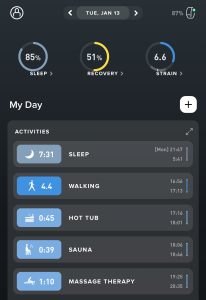
45 min Onsen, 45 min Sauna, and 70 min massage
It’s also very possible that the improvement came from a combination of two or all three factors above.
Next step for me: Repeat each of these interventions independently to isolate the main cause, then share the most effective one with you all so you can try it too.
Stay tuned for more experiments and real results!